
What Is A 10b5-1 Plan?
Back in the olden times of physical offices, when OpenAI was just a few data scientists and a dream working for a nonprofit, and BKFi was still in its infancy, a few employees at Etsy took a chance on us to help them diversify their stock (this was around 2018). They came with RSU grants on wild vesting schedules and the worst equity platform you’ve ever seen. It was impossible to get data, confusing to sell anything, and we tried our best to help them navigate trading windows, blackouts, and more.
We took their equity grants, made hilariously complex spreadsheets, and fed those spreadsheets into tax software. We’ve come a long way since then. We built our own 10b5-1 generator, Gemifi, which manages the tax implications of every single sale lot.
I think we did alright considering the tools we had at the time. But with one of our favorite clients, we came up against something we had only read about in our textbooks: a 10b5-1 plan. Our client got a scary email from legal saying that because of their new role, they’d be shut out of upcoming trading windows, and that if they wanted to keep selling, they’d need a 10b5-1 plan in place. So in typical BKFi fashion, we learned everything we possibly could and got to work. The actual deliverable was a horrendous Excel sheet, but in reality, that’s what a 10b5-1 plan is: a list of trades you want to make in the future. What you want to sell, and when, gets submitted to the company’s legal team and then executed by the broker (Fidelity, Schwab, Morgan Stanley, and so on).
What Is a 10b5-1 Plan?
A 10b5-1 plan is a written plan, set up in advance, that tells your broker to sell (or buy) your company’s stock on specific dates, at specific prices, or by a formula you choose ahead of time. Because you adopt it when you don’t have material nonpublic information, trades that follow the plan give you an affirmative defense against insider trading claims, which is why insiders can keep selling through blackout periods. The name comes from SEC Rule 10b5-1, and if you’ve ever seen “Rule 10b5-1 trading arrangement” in your company’s 10-Q, this is what they’re talking about.
EligibilityDo I Need a 10b5-1 Plan?
You probably need one if your company has told you you’re an insider, your trading windows keep closing before you can sell, or you’re coming off an IPO lockup with way too much of your net worth in one stock. Directors and officers use them most, but plenty of employees in finance, legal, product, and deal teams end up designated as insiders too, and some companies offer plans to everyone. Your company’s insider trading policy decides who’s eligible, so ask your stock plan administrator for it before anything else. If you’re still pre-IPO, our guide on how to prepare for an IPO covers what to line up before the lockup ends. There is a trend in recent IPOs for MORE employees to use 10b5-1 plans. We think they are a good idea even if you don’t need one. It takes the stress of diversification and relieves you from having to make a major financial decision during every single open trading window.
The ProcessHow Does a 10b5-1 Plan Work?
You decide on your trades in advance, ostensibly when you don’t yet know the “material non-public information” yet. Then the plan sits through a cooling-off period, and then your broker executes it on autopilot. The plan gets adopted during an open window on your broker’s template (Fidelity, Schwab, Morgan Stanley at Work, and E*Trade all have one) after your company’s legal team approves it, and directors and officers also certify in the plan that they don’t have inside information and are acting in good faith. The paperwork is the easy part, and the hard part is deciding what goes in it, which is where we come in.
Working With UsHow BKFi Sets Up Your 10b5-1 Plan
We handle the analysis and modeling, you make the decisions, and your company’s legal team gets a plan that’s clear, complete, and ready to approve.
We Analyze What You Have
We pull together your grants, vesting schedules, tax lots, and cost basis, along with your company’s insider trading policy and your broker’s plan template, so we know exactly what you own and what rules you’re working within.
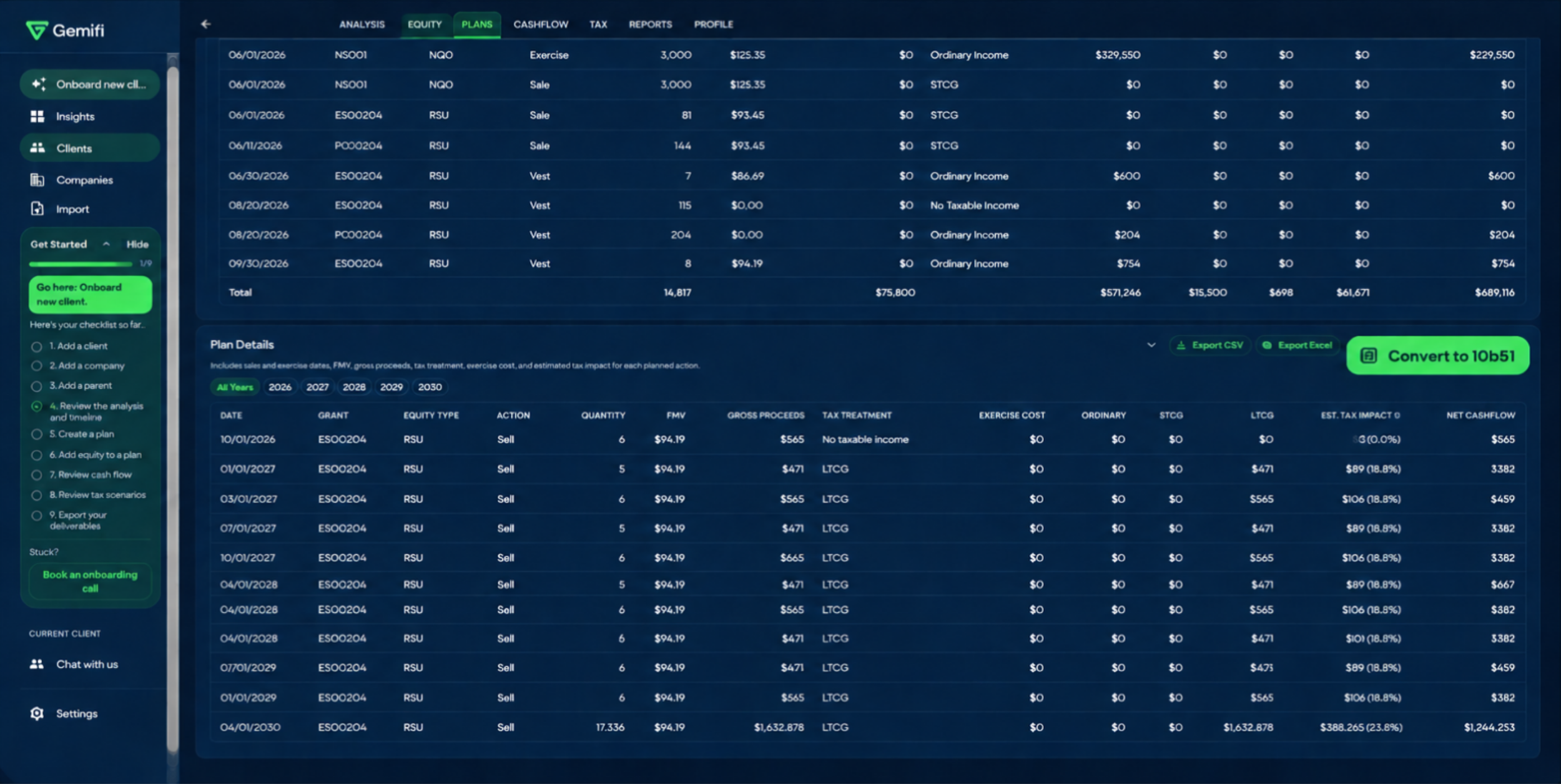
We Do the Modeling
Using Gemifi, we model every sale lot in the plan, including the tax impact, how much cash you’ll need for estimated payments, how quickly you’re diversifying, and where limit prices make sense, and we flag traps like wash sales around vest dates before they happen.
You Review and Sign Off
We walk you through the plan, adjust anything that doesn’t feel right, and nothing moves forward until you’ve approved it.
You Submit It to Legal
Once you’ve signed off, you submit the plan to your company’s legal team during an open window, and after they approve it, your broker takes it from there.
What Are the 10b5-1 Rules in 2026?
If what you know about 10b5-1 plans predates 2023, it’s out of date, because the SEC tightened the rules that year and a lot of what’s online still describes the old version where you could adopt a plan and start selling almost immediately.
| Who You Are | Cooling-Off Period Before Your First Trade |
|---|---|
| Directors and officers | The later of 90 days or two business days after the company files its 10-Q or 10-K for the quarter you adopted the plan, capped at 120 days |
| Everyone else | 30 days |
Beyond the cooling-off period, you have to act in good faith for the entire life of the plan, you generally can’t run overlapping plans (a separate sell-to-cover arrangement for RSU tax withholding is one of the exceptions), and a plan built to sell everything in one trade can only be used once every 12 months. Changing the amount, price, or timing of trades counts as starting a new plan, cooling-off period included. Companies also now disclose when their directors and officers adopt or end plans, and Form 4 has a checkbox showing which sales happened under one.
How Are 10b5-1 Sales Taxed?
A 10b5-1 plan doesn’t change how your stock is taxed, but it locks in your trades months ahead of time, so the tax planning has to happen before you sign since you can’t tweak things in December. RSUs are taxed as ordinary income when they vest, and companies often withhold federal tax at a flat 22%, which leaves most of our clients short at tax time (more on that in our post on RSU tax withholding), so we usually build extra sales into the plan to cover estimated payments. If you have ISOs, selling before you’ve held the shares a year from exercise and two years from grant turns capital gains into ordinary income. Lot selection matters a lot when you’ve been accumulating shares for years, and one trap catches people constantly: selling shares at a loss within 30 days of an RSU vest triggers a wash sale, because the vest counts as buying new shares. This is exactly the lot-by-lot math we built Gemifi to handle.
StrategyHow Should I Set Up the Trades?
Most of the plans we build start with a base layer of time-based sales that covers taxes and core diversification, with limit-price tranches on top that only sell if the stock climbs. Limit prices feel smart, but if your stock never hits them, nothing sells, and you end the year with the same concentration problem and an unfunded tax bill. The other mistakes we see most often are plans too short to be worth the cooling-off wait and people starting to plan the week the window closes, which leaves no time for the part that actually matters. (If you’re wondering whether to sell at all, start with should I sell my RSUs immediately?)
Common QuestionsFrequently Asked Questions
How long does a 10b5-1 plan last?→
Most run between six months and two years, depending on your company’s policy and your goals.
Can I set up a 10b5-1 plan before my IPO lockup ends?→
Often yes, if your company allows it. Adopting the plan during an open window before the lockup expires lets the cooling-off period run at the same time, so sales can start soon after the lockup lifts.
Can I cancel or change my 10b5-1 plan?→
You can cancel, but any change to how much, at what price, or when is treated as a new plan with a new cooling-off period, and frequent changes can undermine the good faith your protection depends on.
Does a 10b5-1 plan protect me from insider trading claims?→
It gives you a strong affirmative defense if you adopted the plan properly, without inside information, and followed it in good faith.
Can a financial advisor help me set up a 10b5-1 plan?→
Yes. Your company’s legal team approves the plan and your broker executes it, but neither one will tell you what you should actually sell, when, or what it means for your taxes. That’s the planning work we do for our clients before the plan ever reaches legal.
This article is for educational purposes and is not personalized investment, tax, or legal advice. Your equity, your tax situation, and your goals are unique, so talk to a qualified advisor before making decisions.
We handle the analysis and modeling, you make the decisions, and your company’s legal team gets a plan that’s clear, complete, and ready to approve.
Talk To BKFi